Machine control software
LPBF controllers built on AMCF: state machines for the complete build cycle, recoating and exposure sequences, interlocks with the PLC and recovery after interruptions.
Laser Powder Bed Fusion · Machine Control
C1 Technologies develops, integrates and supports the software that runs LPBF metal 3D printers: from build data and laser scanning to sensors, operator interface and process data. Built on the open-source Autodesk Machine Control Framework.
The process
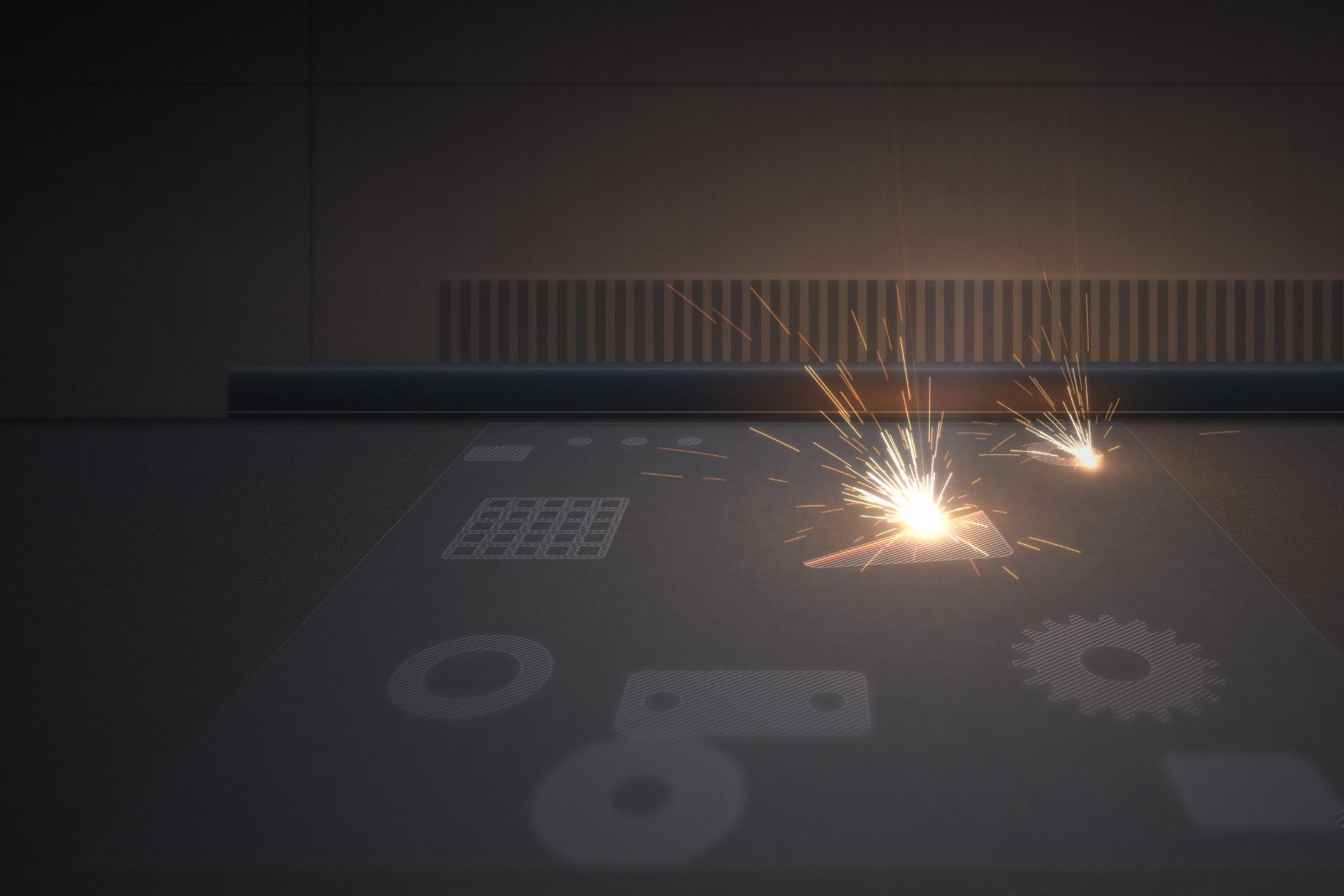
LPBF, also known as selective laser melting (SLM) or DMLS, builds dense metal parts layer by layer. A laser melts thin layers of metal powder exactly where the part should be. A single build can consist of thousands of layers and millions of laser vectors, and every one of them is executed by the machine control software.
The 3D model is oriented, supported and sliced into layers. Scan vectors and laser parameters are assigned per part, region and hatch.
build file import (3MF Toolpath), parameter sets, job queue
The chamber is flooded with argon or nitrogen until residual oxygen is very low, typically below 0.1 %. A laminar gas flow carries fumes and spatter away from the laser.
gas and oxygen control, interlocks, alarms
A recoater spreads a thin layer of metal powder over the build platform, typically 20–100 µm thick.
recoater motion, powder dosing, layer imaging
Galvanometer scanners steer one or more fibre lasers across the layer. Contour and hatch vectors melt the powder; the melt pool solidifies within milliseconds.
scanner and laser control, multi-laser coordination, monitoring
The platform lowers by one layer thickness and the cycle starts again, thousands of times over hours or days.
state machines, recovery after interruptions, build journal
After cooling, parts are depowdered, stress-relieved and cut from the build plate, then finished by heat treatment, HIP, machining or surface treatment.
traceable build records for quality assurance
Applications
Complex metal parts that are hard or impossible to machine or cast: internal cooling channels, lattices, lightweight structures and assemblies consolidated into one part.


What we do
From a single driver to a complete machine controller: we develop the software layer between your build data, your hardware and your operators.
LPBF controllers built on AMCF: state machines for the complete build cycle, recoating and exposure sequences, interlocks with the PLC and recovery after interruptions.
Scanner and laser controllers, PLCs, motion axes, gas and oxygen sensors, cameras and pyrometers, wrapped as C++ driver plugins with simulation counterparts for testing.
From CAD/CAM such as Autodesk Fusion to the scanner: 3MF Toolpath import, parameter sets per part and hatch, build validation and job management.
Web-based operator UI configured on the server side: roles and permissions, live machine status, layer and toolpath viewers, charts and alarms, on the machine and in the browser.
A complete build journal with sensor time series and user actions, linked to every layer and part and exportable through the REST API to MES, QMS and analytics tools.
Modernise existing LPBF machines or build open research platforms where every parameter, sensor and scan strategy is accessible to your engineers.
The platform
AMCF is an open-source middleware framework that connects CAD/CAM software with machine hardware in a closed-loop system. It was originally developed for laser-based additive manufacturing and is published by Autodesk under the BSD-3-Clause license.
A headless C++ server runs inside the machine. Machine logic and hardware drivers are plugins, separated from the framework core. Operators and other systems work through a web interface and a documented REST API.
The framework is free to use, modify and ship. You keep full control of your machine software and its roadmap.
Machine logic and drivers are separated from the framework core, with independent release cycles.
Deterministic, inspectable machine behaviour that can be visualised in the user interface.
State and variable changes are recorded, so complete builds can be replayed and analysed.
Machine logic is developed and tested without hardware, before it reaches the machine.
Login, roles and permissions; every action is attributed to a user and a point in time.
Who we work with
Launch a new LPBF system with a modern, open control stack instead of developing one from scratch.
Open research machines with full access to scan strategies, process parameters and raw data.
Make your scanner, laser, optics or sensor available to LPBF machines as an AMCF driver.
Retrofit and extend existing machines and connect them to factory IT and quality systems.
How we work
Requirements, hardware inventory, process goals and constraints.
Control concept, state machines, interfaces and the safety split between PLC and PC.
Drivers and plugins, developed against simulation and covered by automated tests.
On the machine, together with your process engineers, up to the first builds.
Updates, new features, training and maintenance over the machine's life.
Why C1 Technologies
Your machine software is built on an open framework. Source access, open data formats, no lock-in.
Lasers, scanners, recoating, gas flow and monitoring: we understand the process the software controls.
Modern C++, versioned builds, continuous integration, automated tests and simulation.
From the first architecture sketch to commissioning and long-term support.
FAQ
AMCF is an open-source middleware framework, published by Autodesk, that integrates CAD/CAM software with machine hardware. It was originally developed for laser-based additive manufacturing. A headless C++ server runs on the machine; drivers and machine logic are plugins; clients use a REST API documented with OpenAPI 3.0.
No. AMCF is licensed under BSD-3-Clause, so you can use, modify and ship it in your product. We offer engineering, integration and support around it.
Usually yes. If a component has an SDK or a documented protocol, it can be wrapped as an AMCF driver plugin. We also write a simulation driver for it, so that the machine logic can be tested without the hardware.
Often yes, depending on access to the scanner, the laser and the PLC. We start with a hardware inventory and a short feasibility study.
AMCF uses the 3MF Toolpath format for build data and connects to Autodesk Fusion. Other build file sources can be connected through import plugins; tell us about your workflow.
No. The AMCF server runs inside the machine, and the operator interface runs in a browser on the local network. Connections to factory or cloud systems are optional and go through the REST API.
Contact
New machine, retrofit, research system or a single driver: tell us what you are building. An engineer will get back to you.